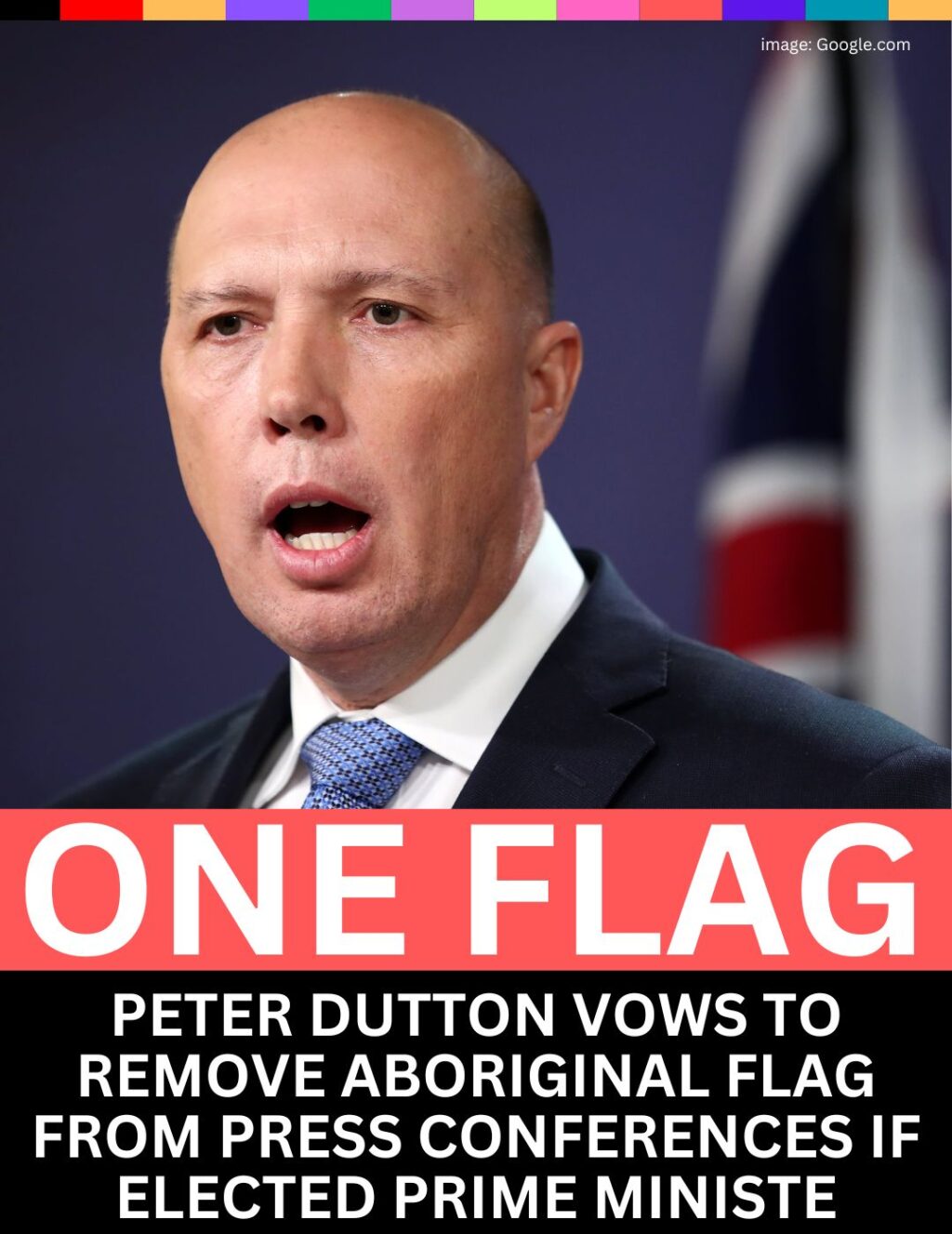
Opposition Leader Peter Dutton has sparked controversy by declaring that he will not display the Aboriginal flag during press conferences if he becomes Prime Minister. Speaking firmly on the matter, Dutton stated, “We have one national flag,” emphasizing his stance on prioritizing the Australian flag as the sole emblem of national unity in such settings.
This announcement comes as debates about the symbolism and inclusion of the Aboriginal flag continue to divide public opinion across Australia. Currently, the Aboriginal and Torres Strait Islander flags are often displayed alongside the Australian flag at official events and government buildings as a recognition of the country’s First Nations peoples and their cultural significance.
Dutton’s position marks a significant shift from the inclusive approach embraced by many leaders in recent years. His comments have already drawn mixed reactions from politicians, advocacy groups, and the broader public.
In elaborating on his decision, Dutton argued that having a single national flag in official settings symbolizes unity for all Australians. He suggested that displaying multiple flags during press conferences could undermine the notion of a cohesive national identity.
“The Australian flag represents every Australian. It unites us all, regardless of our background or heritage,” he said.
While Dutton acknowledged the cultural importance of the Aboriginal flag, he maintained that its place should remain in specific cultural or ceremonial contexts, rather than at government press conferences.
The Opposition Leader’s statement has drawn criticism from Indigenous leaders and advocacy groups, who argue that removing the Aboriginal flag sends a divisive message. Many see the flag as a vital symbol of recognition and respect for Australia’s First Nations peoples and their historical connection to the land.
One prominent Indigenous leader remarked, “This is not just a piece of fabric—it’s a representation of our culture, resilience, and rightful place in the nation.”
On the other hand, Dutton’s supporters have praised his stance as a move to simplify and refocus national identity on shared symbols. Some conservative commentators have lauded the decision as a rejection of “symbolic politics” in favor of policies that prioritize all Australians equally.
Dutton’s announcement comes against the backdrop of heightened tensions surrounding Indigenous issues, including the recent Voice to Parliament referendum, which was rejected by a majority of Australians. The result has intensified debates on the best way to address Indigenous representation and equality in the nation’s governance.
As the next federal election approaches, Dutton’s stance on the flag is likely to become a key talking point, particularly as it touches on broader themes of national identity, inclusivity, and reconciliation.
Whether this position will resonate with voters or alienate segments of the population remains to be seen. For now, Dutton’s declaration has added another layer of complexity to the ongoing conversation about Australia’s identity and the role of its Indigenous heritage in shaping the nation’s future.