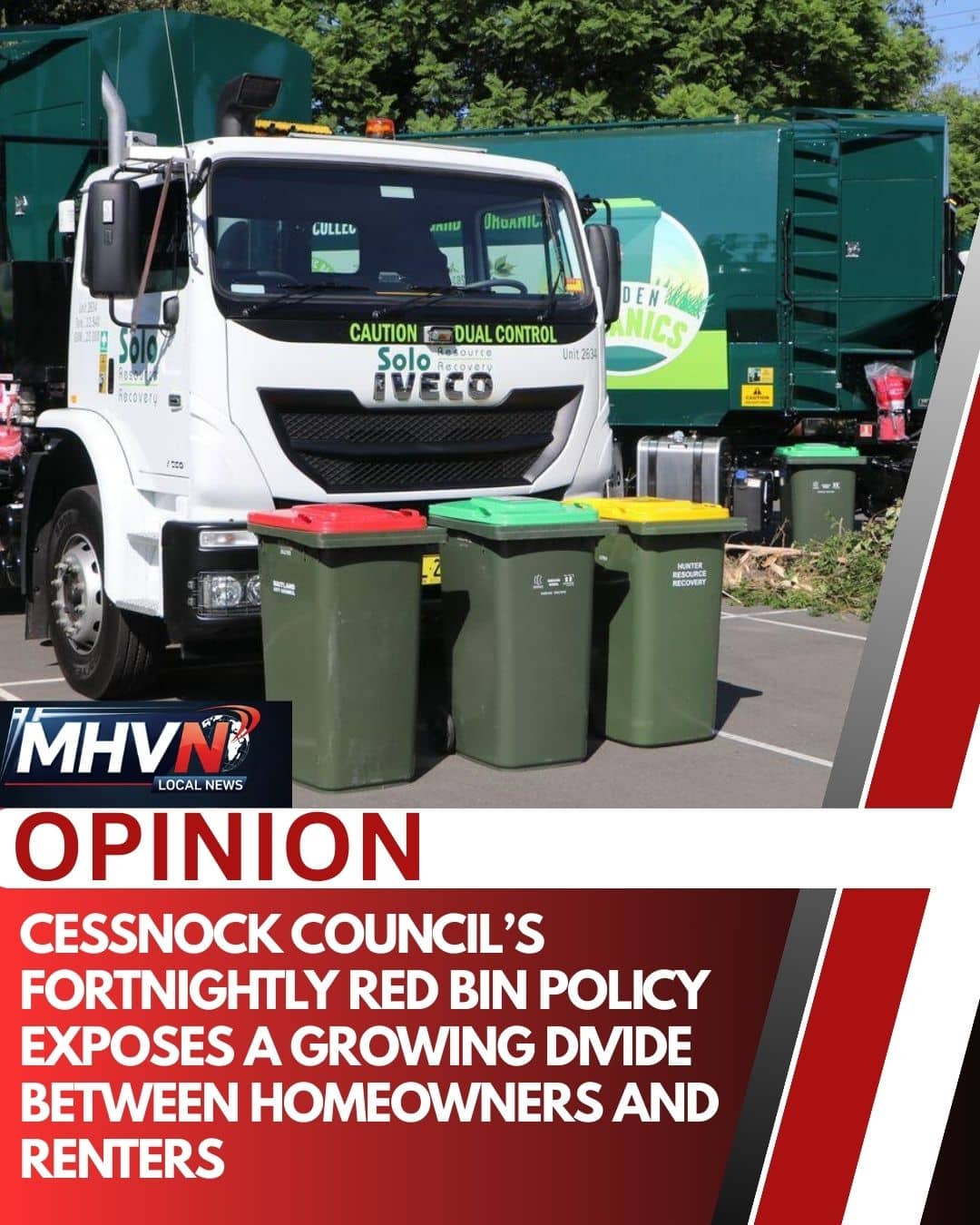
Cessnock Council says its new fortnightly red bin collection is about waste management reform, environmental policy, and reducing landfill. That’s the official line. But in reality, this local government decision reveals something much bigger—and much uglier—about life in regional Australia during a housing affordability crisis. This policy creates a two-tier system based on property ownership, where homeowners get choice and financial benefits, while renters get no say at all.
If you own your home in Cessnock, you’re treated like a customer. You can opt in or opt out. You can choose weekly or fortnightly waste collection. You receive a discount on your domestic waste charge—up to $95 annually. You have flexibility. You have options. You have control over a basic local government service that directly affects your daily life.
If you rent, you get none of that.
Your landlord decides. The council decides. You live with the consequences.
In the middle of a national rental crisis and cost of living pressures, Cessnock Council has introduced a policy that directly benefits landlords while pushing inconvenience, hygiene risks, and discomfort onto tenants. Two weeks of general waste sitting in a red bin during summer isn’t an abstract policy debate—it’s a real-world problem for renters who already pay rising rents, rising power bills, and rising council rates indirectly through their lease.
Council claims this policy builds on the “success” of FOGO. But at the same time, the council has openly complained about contamination in FOGO bins, blaming residents for not separating food and garden waste correctly. So which is it? Is the system working, or isn’t it?
Instead of fixing contamination through education, infrastructure, or enforcement across the board, council has chosen to reduce services—then lecture residents about environmental responsibility. That’s not sustainable waste management. That’s shifting responsibility downward while protecting property owners at the top.
This is where the policy becomes divisive.
Homeowners can decide what works best for their household. Renters—who now make up a growing share of the local population due to housing affordability pressures—are locked into whatever arrangement benefits the property owner. And let’s be honest: the overwhelming majority of landlords will not pass waste charge savings on to tenants. Anyone who thinks otherwise hasn’t been paying attention to the rental market.
So what does this create?
A two-tier waste system.
A two-tier council service.
A two-tier standard of living.
One tier for people who own property and accumulate wealth.
Another for people who rent and absorb inconvenience.
Council calls this an “opt-in” program. But renters aren’t opting into anything. They’re being opted into a system that treats them as an afterthought. In a time when renters are already politically invisible—locked out of home ownership, struggling with housing supply shortages, and facing relentless cost of living increases—local government has decided their comfort is optional.
And this is the bigger issue.
This isn’t really about bins. It’s about how local government policies quietly reinforce class divisions while hiding behind environmental language. It’s about who gets choice and who gets told to adapt. It’s about whose voices matter when council designs services—and whose don’t.
Cessnock Council didn’t just change a waste collection schedule. It sent a message: if you own property, you matter more. If you rent, you’ll cope.
Two bins.
Two classes.
One very clear lesson in modern local government priorities.
And for renters, that lesson is impossible to ignore—because it smells.