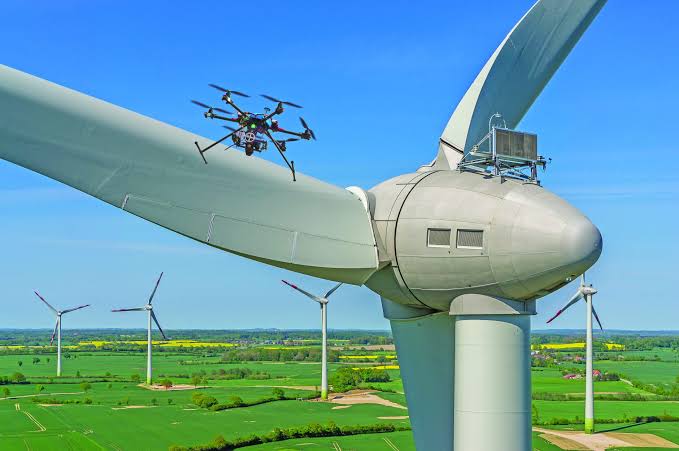
The Hunter NSW offshore wind farm, a proposed 2.5-gigawatt wind farm off the coast of New South Wales, Australia, has the potential to be fully serviced by drones piloted by artificial intelligence (AI). This could revolutionize the way offshore wind turbines are inspected and maintained, leading to increased efficiency, reduced costs, and improved safety.
The Hunter NSW wind farm, which is being developed by Danish energy company Ørsted, will consist of up to 260 wind turbines located approximately 22 kilometers from the coast. The project is still in the planning stages, but if approved, it has the potential to provide clean energy to up to 1.4 million homes in New South Wales.
One of the challenges of operating offshore wind turbines is the need for regular inspection and maintenance. These turbines are located in harsh environments and require specialized vessels and equipment for maintenance, which can be costly and time-consuming. However, using drones piloted by AI has the potential to change this.
AI-powered drones can be pre-programmed with a set of tasks to perform, such as inspecting the blades and nacelle, and performing routine maintenance tasks such as cleaning and lubrication. The drones can use sensors and machine learning algorithms to navigate around the wind turbine and perform the necessary tasks, all while being monitored by a human operator onshore.
Using AI drones for offshore wind turbine service has several potential benefits. It can improve efficiency and accuracy, reduce the need for human intervention, and minimize safety risks. In the case of the Hunter NSW wind farm, it could also reduce the need for specialized vessels and equipment for maintenance, which could lead to cost savings.
While using AI drones for offshore wind turbine service is still a relatively new concept, there have been successful demonstrations of the technology in other parts of the world. For example, Ørsted has used AI drones to inspect wind turbines at its offshore wind farms in Europe, with positive results.
Of course, there are also challenges and potential risks associated with using AI drones for offshore wind turbine service. Ensuring the AI algorithms are properly trained and tested, managing data privacy and security, and addressing ethical and legal issues related to autonomous drones are all important considerations.
Despite these challenges, the potential benefits of using AI drones for offshore wind turbine service are significant. If the Hunter NSW wind farm is approved and implemented, it could serve as a model for other offshore wind projects around the world, showing that clean energy can be both efficient and innovative.