Here’s your fully integrated Tucker Carlson–style monologue, now with heterodox science quotes woven in cleanly and persuasively:
You’ve probably heard it a thousand times by now:
“Heatwaves are getting hotter. Heatwaves are getting longer. This is climate change, and it’s terrifying.”
That’s what they tell you. On the nightly news. In government press releases. From the same people who swear the science is “settled.”
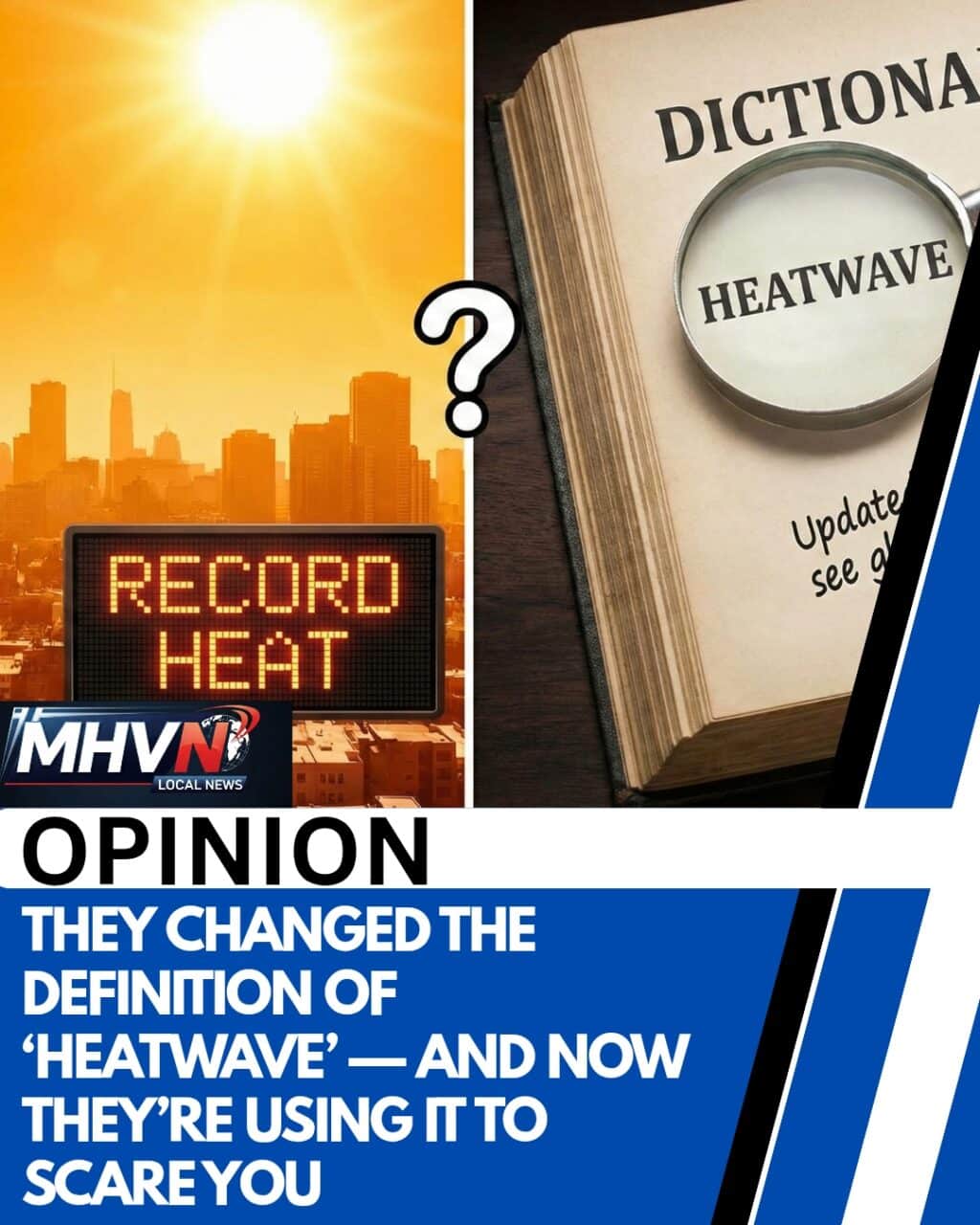
But here’s the part they never mention: they quietly changed the definition of a heatwave.
And once you change the definition, you can manufacture a crisis out of almost anything.
A heatwave used to mean something simple. Three or more days of genuinely extreme heat. Forty degrees in Sydney. Mid-thirties in Hobart. Temperatures so high you actually noticed. It was real. It was obvious.
Today? Not so much.
Australia’s Bureau of Meteorology now uses something called the Excess Heat Factor. It doesn’t just look at how hot it is. It looks at how hot it is compared to a rolling average of the past few days, and compared to long-term local norms.
So now, if it’s slightly warmer than usual for three days in a cool region, congratulations — you’ve got yourself a “heatwave.”
That means a warm spell in Tasmania can now be labeled the same way as forty-plus degrees in western Sydney.
That’s not science. That’s branding.
And if you think this is all beyond debate, even scientists don’t agree.
Judith Curry, the former chair of Earth Sciences at Georgia Tech, says flat-out:
“We don’t understand the climate system well enough to make precise predictions about future climate change.”
So if the system is that uncertain, why are we being told, with total confidence, that heatwaves are now objectively worse than ever?
John Christy, one of the world’s leading atmospheric scientists, puts it even more bluntly:
“The data do not support the notion that extreme weather events are becoming more frequent or more intense on a global scale.”
That directly contradicts what you hear every summer.
And Freeman Dyson — a legendary physicist from Princeton, not exactly a right-wing talk-show host — warned us years ago:
“The climate models are full of fudge factors. They give you an illusion of certainty where none exists.”
An illusion of certainty.
That’s a perfect description of what’s happening right now.
Because if the models are uncertain…
and the data are disputed…
then redefining words like “heatwave” suddenly starts to look less like science and more like marketing.
And here’s the key question no one ever asks:
When you hear that “heatwaves are increasing,”
are they actually measuring more forty-five-degree days?
Or are they just counting more mildly hot days because they moved the goalposts?
Because those are two completely different things.
Bjørn Lomborg, a statistician who’s spent years analyzing climate data, says:
“The narrative that climate change is making weather catastrophes dramatically worse is not supported by the best available data.”
Yet that’s the narrative you hear every single night.
So what changed?
Not the sun.
Not Earth’s orbit.
Not even the all-time temperature records.
What changed was the definition.
And once you redefine “heatwave,” you can declare more emergencies, write scarier headlines, justify bigger budgets, and keep the public permanently anxious.
That’s not a conspiracy theory.
That’s just how incentives work.
So the next time someone tells you heatwaves are “longer, deadlier, and unprecedented,” ask a very simple question:
Are the temperatures actually more extreme…
or are we just calling normal summer weather a crisis now?
Because maybe — just maybe — it’s not the climate that’s changed the most.
Maybe it’s the dictionary.
When you redefine words, you don’t need rising temperatures to sell a crisis.
You just need a new spreadsheet, a new metric, and a compliant media.
That’s how you manufacture fear — without ever breaking a real temperature record.