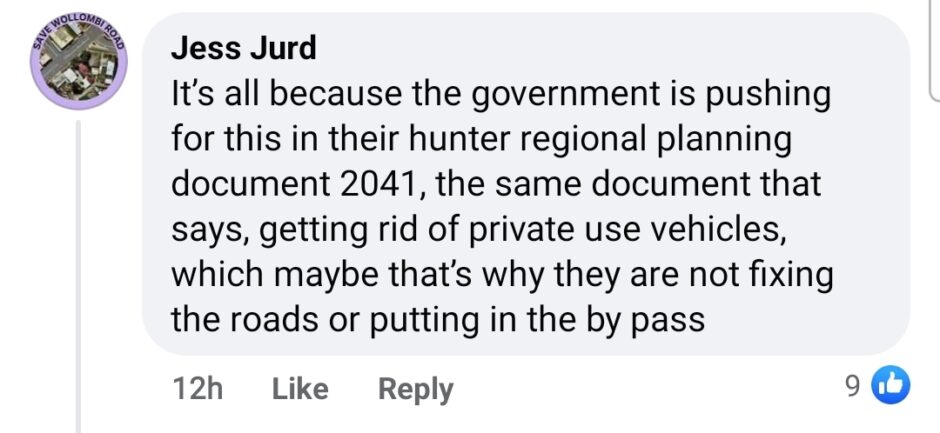
Councillor Jurd’s statement that the Hunter Regional Plan 2041 aims to eliminate private vehicle ownership requires careful analysis, as it contains several inaccuracies and misinterpretations.
Here’s a breakdown of the key points:
Claim: “The government is pushing for getting rid of private use vehicles” in the Hunter Regional Plan 2041.
Verdict: Misleading. The plan does not explicitly say anything about removing private vehicles. Instead, it focuses on creating a multimodal transportation system that reduces reliance on cars and provides alternative options like:
- Expanding public transport: buses, trains, light rail.
- Investing in cycling and walking infrastructure: dedicated paths, improved safety.
- Promoting active travel: walking, cycling for short trips.
Claim: This is why roads are not being fixed or the bypass is not being built.
Verdict: Unfounded. There is no evidence to suggest that the Hunter Regional Plan 2041 is linked to decisions about road repairs or the bypass project. These decisions are likely influenced by various factors, including budget allocations, infrastructure priorities, and environmental considerations.
Additional Points:
- The plan acknowledges the importance of private vehicles and does not propose their outright ban.
- Reducing car dependence has potential benefits like reduced traffic congestion, improved air quality, and lower greenhouse gas emissions.
- The plan emphasizes the need for community engagement and ongoing dialogue to ensure a balanced approach to transportation development.
Conclusion:
While the Hunter Regional Plan 2041 encourages exploring alternatives to private cars, it does not advocate for removing them entirely. Councillor Jurd’s statement lacks context and misrepresents the plan’s objectives. It’s essential to rely on accurate information and factual evidence when discussing complex issues like regional planning and transportation systems.